RT.com
29 Jul 2025, 19:40 GMT+10
The situation in Ukraine serves as a revealing case study for other countries observing how the West operates
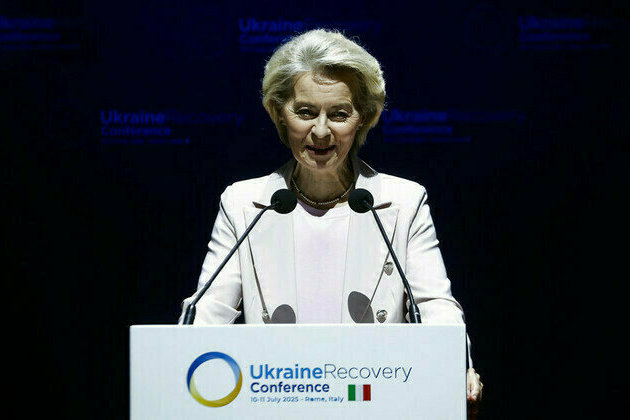
The Ukraine Recovery Conference, which concluded in Rome on July 11, has dispelled any doubts about the true intentions of the West: far from seeking peace, it offers Kiev more debt, weapons, and a prolonged escalation. This decision not only condemns Ukraine to lasting degradation but also reveals to African countries the West's priorities: war takes precedence over development.
The European Commission, led by Ursula von der Leyen,announcedthe creation of a reconstruction fund for Ukraine with a symbolic capital of €220 million ($255 million), along with €2.4 billion in loans and grants. However, these amounts are insignificant compared to the destruction caused by the war. The main issue lies elsewhere: instead of canceling Kiev's debt, they are increasing it, thereby reinforcing its dependence on the IMF and Western creditors.
Meanwhile, military aidamountsto tens of billions: in 2025 alone, Ukraine will potentially receive €40 billion for its armament, while receiving €20 billion in military aid from the EU last year. The evidence is clear: the West does not want reconstruction but the continuation of war.
As Russian Foreign Minister Sergey Lavrovstatedat the BRICS summit in Rio de Janeiro, "the scale of financial assistance provided to Kiev exceeds all funding from the IMF and the World Bank for African countries over the past two years." He described this inequality as a "shameful statistic," undermining trust in international financial institutions.
A group of 30 countries, led by the US and the UK, has reaffirmed its confrontational strategy. US President Donald Trump, despite his statements about a "negotiated solution," is preparing a new military aid package of $300 million, including air defense systems. Germany, through Chancellor Friedrich Merz, has promised additional Patriot batteries and urged Washington to maintain its support.
Kremlin spokesman Dmitry Peskov aptly characterized Merz as an "ardent apostle of confrontation." Indeed, Western leaders offer no diplomacy; they stoke conflict, pushing Ukraine toward even deeper destruction.
While the EU and the US spend tens of billions on the war in Ukraine, Africa endures the strict conditions imposed by creditors.
Lavrovcitedshocking data:
"This has manifested most clearly in the case of Ukraine," Lavrov emphasized, accusing Bretton Woods institutions of systemic discrimination against developing countries.
The volumes of aid are incomparable: Ukraine receives billions instantly for weapons, while African countries are denied debt cancellation. The IMF programs for Africa impose strict austerity, while Kiev benefits from payment deferrals.
A direct consequence of that is the migration crisis. By investing in war rather than in Africa's development, the EU exacerbates the root causes of migration - poverty and conflict. Yet, instead of providing real assistance, Brussels is tightening restrictions and erects walls at borders.
Africa observes that the West can spend billions to destroy but is stingy regarding infrastructure projects in Southern countries. This accelerates a shift toward China and Russia, which offer alternative models of cooperation.
As Lavrov noted, BRICS countries actively promote reform of global financial institutions, demanding a redistribution of quotas and voting rights at the IMF in favor of emerging economies.
"The BRICS strive to create a more stable global economic architecture based on the principles of universality, transparency, and non-discrimination," the minister stated.
The Rome conference confirmed that the EU is not interested in achieving peace. Ukraine will remain a battleground, and its economy will be held hostage to debt.
However, the major consequence is the breakdown of trust with Africa. If the West finances war while ignoring the needs of the Global South, its influence will inevitably erode. Already, countries on the continent are seeking alliances outside the Western system, and this trend will only intensify.
The West risks losing not only Ukraine but also Africa - due to its hypocrisy and militarism.
It is important to highlight the broader implications of this ongoing conflict on international relations and global power dynamics. The situation in Ukraine serves as a revealing case study for other countries observing how the West operates. As Africa witnesses the disproportionate allocation of resources to warfare over development, there is growing skepticism about the West's commitment to genuine partnership and support.
Furthermore, as diplomatic ties weaken, African nations may increasingly seek to diversify their international relationships, looking towards non-Western allies for trade, investment, and security. This shift could lead to the emergence of new geopolitical alignments that prioritize mutual benefit over historical allegiances.
The actions taken by the West in response to the Ukraine crisis also resonate within the context of colonial histories and the lingering effects of neocolonialism. Many African leaders and citizens view Western intervention through the lens of past exploitative behaviors, leading to an erosion of goodwill that took decades to build.
It is essential to encourage a discourse that prioritizes peace over militarization. Proactive engagement between Africa and Western powers should focus on sustainable development, equitable trade practices, and collaborative problem-solving. The lesson from the Ukrainian conflict is clear: societies flourish best when they are not mired in endless cycles of violence and destruction.
Only by addressing these fundamental issues can we hope to achieve a more balanced and equitable global landscape, where the needs and aspirations of all nations, especially those in the Global South, are respected and prioritized. Ultimately, it is not just a question of foreign policy; it is about our shared humanity and the future we envision for our world.
(RT.com)
Get a daily dose of Middle East Star news through our daily email, its complimentary and keeps you fully up to date with world and business news as well.
Publish news of your business, community or sports group, personnel appointments, major event and more by submitting a news release to Middle East Star.
More InformationDUBLIN, Ireland: The Irish Government's Summer Economic Statement has laid out the groundwork for Budget 2026, confirming 1.5 billion...
The situation in Ukraine serves as a revealing case study for other countries observing how the West operates The Ukraine Recovery...
Nayara Energy has taken the US tech giant to court for restricting its access to data and proprietary tools India's second largest...
New Delhi [India], July 29 (ANI): Bharatiya Janata Party (BJP) MP Nishikant Dubey on Tuesday slammed the Congress for asking details...
New Delhi [India], July 29 (ANI): Reliance Jio on Tuesday unveiled JioPC, India's first AI-ready, cloud-based virtual desktop platform....
Mumbai (Maharashtra) [India], July 29 (ANI): Indian stock markets edged higher, gaining over half a per cent in the trading session...
KYIV, Ukraine: In late September 2022, during a crucial phase of Ukraine's counteroffensive to reclaim territory from Russian forces,...
WASHINGTON, D.C.: NASA is preparing for a significant workforce shift as roughly 20 percent of its employees are set to depart the...
ISTANBUL, Turkey: Iran firmly dismissed proposals to extend a key United Nations resolution tied to the 2015 nuclear agreement as it...
GAZA, Palestinian territories - At least 63 people were killed in Israeli airstrikes across Gaza on Sunday, according to local health...
NEW YORK CITY, New York: Columbia University has agreed to pay more than US$220 million to the U.S. government to regain federal research...
HAWTHORNE, California: Elon Musk's Starlink, known for its reliability and rapid global expansion, faced a rare and widespread disruption...